BAKING TIPS: Pastry. Savoury, sweet or vegan – these are my top tips…

So, let’s start with a real basic – necessary for all baking –Traditional Pastry.

In my opinion the best mix to use is not the one you’ll see in all the cookery books from Delia to Paul Hollywood; it’s mine!

This is (roughly): 

  • Half Plain Flour 
  • Half Self-Raising Flour 
  • Half Butter 
  • Half Lard  
  • Salt (1/2 a teaspoon to each 8 oz [227g] flour) 

Rubbed in by hand as I always did in my early years. It wasn’t until much later in life when I could afford a food processor, a Magimix. This remains to today my pride and joy (other brands and makes are available!)

For sweet pastry add icing sugar (two tablespoons per pound [454g] of flour), stirred into the initial dry mixing.  

Something to note is that my measurements can sometimes be quite approximate and a bit mixed. I am a great believer in having recipes as a basis to work from; if they need changing then do so to meet your own tastes or requirements. 

For savoury pastry grated cheese, seeds, herbs and/or spices can be added, again to the dry mix.  

A beaten egg and cold water solution is used to bind the bread crumb like mix together. Always do this by hand – that is with a large flat-bladed (palette) knife with a cutting action across the mix. Add the liquid little-by-little, DO NOT add too much!  

Sprinkle –> Cut –> Mix 

until everything is just coming together. Then, use your had to gently make a ball of dough. Now we are ready for Rolling Out

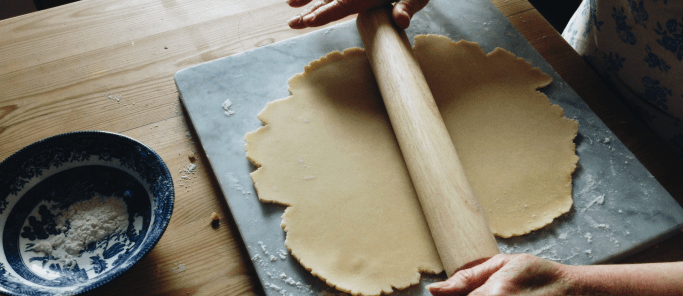
Sprinkle your work surface with semolina and flour (Yes! It gives the pastry a nice crunch) – use just flour if semiolina isn’t in your store cupboard. Place the dough ball on the surface and press gently with the side of your hand to flatten out. Next, using a rolling pin (preferably a long one with handles, lightly floured) gently roll out the dough, turning often, until you have a reasonably thin rectangle or circle to the shape of your plate or dish. Leave dough slightly thicker for a top crust. 

Even suitable for vegans…

My youngest granddaughter is vegan, so I now make a version of the pastry for her – which the rest of the family say is as good and as tasty as my tried and trusted one.

Trex and Cookeen are the plant-based fats I’ve found to be best suited, although I’m sure many others are available. I’ve rubbed this with a half plain / half wholemeal self-raising mix (salt as in traditional pastry).  

If you’ve read any of my life tales – then you’ll know I’d love to be demonstrating my methods. Nothing beats face-to-face and doing, not just talking. My eldest granddaughter (who understands this new fangled internet stuff!) suggested the blog and, you know what, I do feel as if I’m speaking to you – if anyone is actually taking any notice of course! 

I’m leaving you now but I’ll be back – perhaps talking about scones (a similar method to pastry) and suet crust (traditionally used for meat based pies).  

Bye for now. Definitely au revoir and not adieu.

I’d love to see if you test this recipe. Send me your pictures – I’m @gran.e.bakes on Instagram.

BAKING TIPS: Social Distancing – Bakes for when staying home. Part 1.

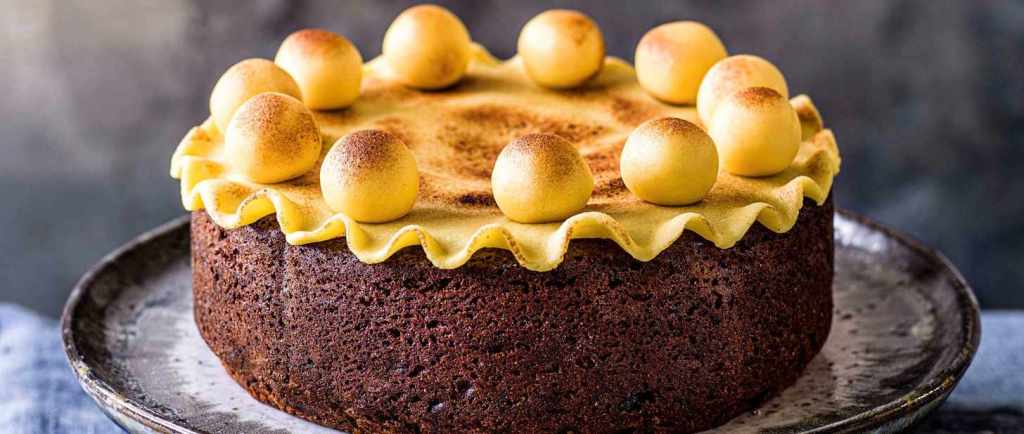
What a strange, scary-sad time we are experiencing, unlike any other period I have known.  Having an interest in food and cooking is keeping me sane. Flour is in short supply – although I usually keep a good stock (which is dwindling) – an appreciated Mother’s Day gift of 2 large bags was very welcome. Over Easter I was trawling my old recipes – an unusual Simnel cake using chocolate is a tasty treat!  

You will need a deep 8” (20cm) cake tin with a loose base or a springform tin, greased and lined. Set the oven to gas 4 (160 fan). 

Ingredients: 

  • 8oz raisins – soaked in (enough to cover) a sweet sherry, wine or amaretto liquor is good 
  • 8oz butter – a block, softened 
  • 8oz golden/caster sugar 
  • 4 large eggs – beaten 
  • 9oz plain flour 
  • 2oz coco powder 
  • 1 level teaspoon baking powder 
  • 1 level teaspoon bicarbonate soda 
  • 1 teaspoon vanilla essence 
  • 1 small carton plain yogurt or soured cream 
  • 1 packet of block marzipan (to cover the finished cake) plus an extra block to form eleven small balls (apostles!) to decorate 
  • 1 bar plain chocolate to melt over the marzipan 

Method 

  1. Mix all the dry ingredients together in a bowl 
  1. Beat together the butter and sugar in a separate bowl 
  1. Slowly add the egg and vanilla essence to the butter and sugar 
  1. Fold in the dry mix 
  1. Add the fruit with the liquid, yogurt/soured cream 
  1. If the mixture is still a little stiff, add a drop of milk 
  1. Transfer to the tin and bake for 1 hour and 15 minutes 
  1. Test the centre with a metal skewer, it should come out clean (if not put back into oven cover top with greaseproof paper and give it another 10 minutes) 
  1. Once cooked, leave to cool 
  1. Brush the top of the cake with warm Jam (to stick the marzipan) 
  1. Dust surface of the table and rolling pin with icing sugar and coco powder to prevent sticking 
  1. Roll out the marzipan (if it’s difficult put it in the microwave for 10 seconds) and lay over the cake 
  1. Make 11 balls of marzipan and roll them in the coco and icing sugar 
  1. When the cake is covered in jam – then marzipan – melt the chocolate with a knob of butter and pour over the cake, place the balls around the edge  

Vegans, have you discovered the alternative to egg whites?

Aquafaba! Yes, this magic liquid comes from draining your chickpeas! It does take longer to whisk – but reasonable results are obtained. A large stand mixer works best and you can leave it running whilst getting on with preparation. A hand (electric) whisk does the job as well, although you need to stand for around 10 minutes – perhaps the aquafaba in some tins is more watery. 

Before you venture into proper meringues, maybe you would like to try this simple version.

Macaroon biscuits. 

  • Aquafaba from chickpeas thoroughly whisked until fairly stiff 
  • 4oz caster sugar 
  • 1 teaspoon corn flour  
  • 2oz ground almonds 
  • 4oz desiccated coconut 

Method 

  1. Put the oven to gas 4 (fan 160-170) 
  1. Mix together the dry ingredients 
  1. Gently fold into the whisked aquafaba (make sure the dry mix is well incorporated) 
  1. Have ready 2 baking sheets lightly greased and covered with baking paper or rice paper 
  1. Place a dessert spoon full of mix – widely spaced – onto baking sheets. Flatten slightly with the back of the spoon (dipped in water to prevent sticking) 
  1. Bake for 20-30 minutes until firm (not brown) 

I’ll sign off this section – asking you all to stay positive – keep in touch with family and friends… from a distance! Live from week to week, this will pass.  

Love to you all, Gran E 

I’d love to see if you trial this recipe. Send me your pictures – I’m @gran.e.bakes on Instagram.
LIFE TALES: Everyone starts somewhere. And I started here.

Back to early on in my journey.

Having little or no money meat was never high on my list – cheese and vegetables always a better option even then in the 1960’s (vegetarianism isn’t a recent thing!). My husband played football and cricket, always inviting his pals back for supper. Cheese and onion pies were a firm favourite. 

Party food at this time was sausage rolls, the aforementioned cheese and onion delights, the Hedgehog (pineapple and cheese chunks on cocktail sticks stuck into an upturned grapefruit!) and vol au vents – mini pastry cases filled with prawns or mushrooms in sauce. I hear this retro style is making a comeback! 

Needing an outlet for myself I joined a friend who scoured fashion warehouses for slight seconds and samples. We sold these at house parties (very popular at the time) along with jewellery, make-up and other household stuff – a great way for young mums to socialise. 

We did very well with the clothes, branching out into fashion shows before opening a shop. In the 1970’s this was before small boutique-style outlets came into vogue. 

As my children grew up we had many parties for them and their pals. My meat and potato pies with beans and/or mushy peas were always a favourite – this theme remains strong 40 years later! 

After a few years in the rag trade another friend proposed a radical change of direction – a garden centre were looking for a cook “with ideas” to open a cafe – again, the norm today but quite unusual at the time. 

I became well known for menus, many of the items unheard of at the time; 

  • It was the era of the quiche – very new, a savoury custard tart! – with my mixes of vegetables and herbs (“what the ‘ell are they?”!)  
  • Homemade Soups – carrot and coriander a real favourite 
  • Individual variations on my meat pie 
  • A range of fruit flans including banana and custard, carrot cake  

This all went down a storm, the owner of the garden centre was delighted. However, never being one to stand still I was intrigued when another new invention appeared – microwave ovens! I was offered a role demonstrating this amazing space-age technology in large stores around Yorkshire and Derbyshire. After attending a training course at the Philips factory I returned home with a large appliance to practice cooking techniques and recipes on and a list of locations keen to see this new fangled wizardry! It was a fascinating and informative role but quite exhausting, travelling hundreds of miles in my car packed full with food and equipment. 

Even today I would not be without my microwave, but as an aid to cooking, not a replacement. You can save time starting food in the microwave – particularly roots for roasting or apples for pies. 

So, with the UK covered came my next challenge – California beckoned!

Bye for now.