Let’s continue with scones. This is a similar method to pastry but with a different ratio of fat to flour. Scones need a hot oven so don’t forget to pre-heat to around 220 degrees, around gas mark 7 or 8.
The basic ingredients for 6-9 scones (depending on size!):
10oz [284g] Self raising flour
2oz [57g] butter
½ teaspoon salt
A large egg (beaten)
Milk (around ½ a cup) to add gradually
For sweet scones:
2oz [57g] of caster sugar
3-7oz ([85-190g] dried mixed fruit, chop small especially if using apricots or dates
Savoury Scones:
5oz [140g] or so grated cheese
Teaspoon of mustard mixed in with the egg
Herbs/Olives/Sundried Tomatoes can be added to the dry mix
After rubbing in the fat into the flour add your dry ingredients. Next add the beaten egg and mix with a palette knife. The dough should be much softer than pastry but not sticky wet!
Handle the dough as little as possible – the heat and moisture from your hands can have a significant impact. Form into a soft ball on a floured work surface. Pat this ball gently out into a flat shape about ¾inch [2cm] thick, but not too thin.
For small scones use your smallest serrated round cutter. Alternatively, pat into larger circles and cut across the top into wedge shapes. Brush the top of your scones with milk; for cheese scones sprinkle a little grated cheese over the tops.
Keep an eye on your scones whilst in the oven, they cook quickly. You’ll see them rise after about ten minutes, then need a further 10-15 mins according to your oven. The tray may need to be turned around. When the scones are ready remove from the oven and cool on a wire rack.
Bye for now!
I’d love to see if you test this recipe. Send me your pictures – I’m @gran.e.bakes on Instagram.
So, let’s start with a real basic – necessary for all baking –Traditional Pastry.
In my opinion the best mix to use is not the one you’ll see in all the cookery books from Delia to Paul Hollywood; it’s mine!
This is (roughly):
Half Plain Flour
Half Self-Raising Flour
Half Butter
Half Lard
Salt (1/2 a teaspoon to each 8 oz [227g] flour)
Rubbed in by hand as I always did in my early years. It wasn’t until much later in life when I could afford a food processor, a Magimix. This remains to today my pride and joy (other brands and makes are available!).
For sweet pastry add icing sugar (two tablespoons per pound [454g] of flour), stirred into the initial dry mixing.
Something to note is that my measurements can sometimes be quite approximate and a bit mixed. I am a great believer in having recipes as a basis to work from; if they need changing then do so to meet your own tastes or requirements.
For savoury pastry grated cheese, seeds, herbs and/or spices can be added, again to the dry mix.
A beaten egg and cold water solution is used to bind the bread crumb like mix together. Always do this by hand – that is with a large flat-bladed (palette) knife with a cutting action across the mix. Add the liquid little-by-little, DO NOT add too much!
Sprinkle –> Cut –> Mix
until everything is just coming together. Then, use your had to gently make a ball of dough. Now we are ready for Rolling Out.
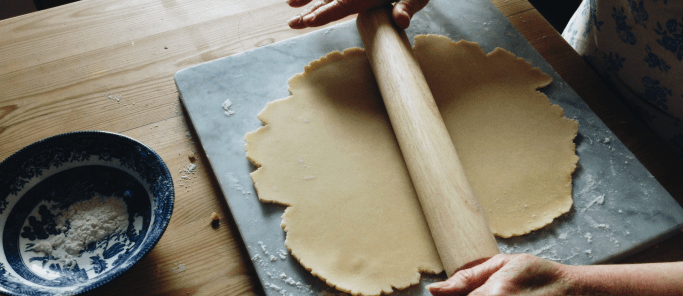
Sprinkle your work surface with semolina and flour (Yes! It gives the pastry a nice crunch) – use just flour if semiolina isn’t in your store cupboard. Place the dough ball on the surface and press gently with the side of your hand to flatten out. Next, using a rolling pin (preferably a long one with handles, lightly floured) gently roll out the dough, turning often, until you have a reasonably thin rectangle or circle to the shape of your plate or dish. Leave dough slightly thicker for a top crust.
Even suitable for vegans…
My youngest granddaughter is vegan, so I now make a version of the pastry for her – which the rest of the family say is as good and as tasty as my tried and trusted one.
Trex and Cookeen are the plant-based fats I’ve found to be best suited, although I’m sure many others are available. I’ve rubbed this with a half plain / half wholemeal self-raising mix (salt as in traditional pastry).
If you’ve read any of my life tales – then you’ll know I’d love to be demonstrating my methods. Nothing beats face-to-face and doing, not just talking. My eldest granddaughter (who understands this new fangled internet stuff!) suggested the blog and, you know what, I do feel as if I’m speaking to you – if anyone is actually taking any notice of course!
I’m leaving you now but I’ll be back – perhaps talking about scones (a similar method to pastry) and suet crust (traditionally used for meat based pies).
Bye for now. Definitely au revoir and not adieu.
I’d love to see if you test this recipe. Send me your pictures – I’m @gran.e.bakes on Instagram.
And it really was! My cousin and her husband had lived there for many years, and were now well established in the Hotel and Restaurant business. They had recently acquired a stunning cliff-top restaurant right on the coastal road. Highway One is spectacular, hugging most of the the California coastline for 656 miles. The main theme was chef’s grilling swordfish, steaks, chicken and ribs on a huge, brick, open-style barbeque cooker. Looking to increase trade at lunchtimes to a wider customer base I was to produce – guess what – quiches and homemade soups! Clam chowder became a favourite alongside my own carrot and coriander soup.
Highway 1
Living with the family in their stunning home in nearby Pebble Beach, driving to work by the ocean, Barbara Streisand on the radio – what kind of a job was that?!
I was gathering tips on; cooking a good lasagne; on blanching spare ribs in boiling water before marinating and slow roasting; the same with squid, blanch first to prevent the rubbery texture, dry well then dip in flour and quickly deep fry – YUM!
Salads and dressings all made from fresh local produce were amazing. One thousand ways with garlic – grown in vast prairie-like fields – practically unheard of or at least not used enough here in the UK. All useful stuff, expanding my ever growing repertoire.
Another English couple owned a tea shop in nearby Carmel-by-the-Sea. They were looking for a cook to produce English style baking, scones, cakes and yes, quiches! So, three mornings a week (stretching to 3pm!), I baked in this quaint cricket-themed caff called The Sticky Wicket. The baking – or rather the preparation – became a feature. Absolutely no-one made pastry from scratch, or scones. Standing there rubbing fat into flour, another demonstrating role was born!
Around the corner was another restaurant. Owned by Clint Eastwood, he was known to pop into the Sticky Wicket for coffee and one of my handmade scones and a chat. He was also a customer at Rocky Point (the cliff-top eatery), being very friendly with my cousins. It was a very busy life but so rewarding; and again, I learned a lot.
But, all good things must come to an end. It was time for me to head back to Sheffield.
Sometimes the simplest bakes become the long-time favourites. If like me you like to spend lazy weekends baking (or everyday in lockdown), these are a perfect choice.
Chocolate Crunch.
Melt 8oz of butter in a pan
In a large bowl mix;
4oz [117g] of cornflakes, crushed with a rolling pin
3 oz [88g] desiccated coconut
5oz sugar (any – brown, white or mixed)
5oz SR flour
2 dessert spoons of cocoa powder (not hot chocolate!)
Add the melted butter to the dry mix
Have ready a well greased swiss roll tin 12”x8”
Press the chocolate mix into the tin, level off with the back of a large spoon
Place the tin in a pre-heated oven, 180 degrees, gas mark 4
Leave on the middle shelf for 20-30 mins
The mix should bubble gently then firm up
When slightly cooled, thickly cover with a mix of plain and milk chocolate (4-6oz)
Maybe add some crushed maltesers or any other left over chocolate, buttons, smarties and the like
Rough up the topping with a fork
Cut into squares whilst still in the tin, before completely cold or you won’t be able to cut smoothly
Lift out with a broad bladed implement when set
This is something quite young children can make, they especially love the sprinkling part. All my grandchildren made this, to be enjoyed by all ages.
Speedy Chocolate Cake.
Another easy, child-friendly bake. This dates back to my daughter’s younger years, this is a useful basic cake made special by the filling and topping.
You will need 2 x 8” sandwich tins, greased and lined with greaseproof paper. Pre-heat your oven to a medium setting – around 180 degrees, Gas Mark 4. Ingredient list:
7oz plain flour
2 tablespoons of cocoa
1 level teaspoon of baking powder
1 level teaspoon of bi-carbonate of soda
5oz of caster sugar (golden is best)
2 large eggs
¼ pint of milk (full cream is best!)
2 tablespoons golden syrup
¼ pint of corn or sunflower oil (yes, really!)
Mix all the dry ingredients in a large bowl. Beat the eggs and milk in a jug. Make a well in the centre of your dry ingredients, pour in the milk and egg mix then drizzle in the golden syrup and oil. Now beat this all together with a wooden spoon until you reach the consistency of pancake batter.
Don’t Panic!
Pour equal amounts into the two sandwich tins. Give a little tap on each tin – you should see bubbles in the mix. Place the tins into the middle of the oven and bake for 30-40 mins – depending on your cooker! The cakes should rise well and be firm(not hard) to the touch. Place the tins on a wire rack to cool.
Toppings and Fillings.
Now onto the special bit. The following are two of my favourites.
1. CLASSIC
A layer of jam (my preference is apricot) topped with butter cream (2oz each of butter and icing sugar whisked together with a little warm cream or milk with ½ a teaspoon of vanilla essence. Place the second cake on top and spread over some melted chocolate.
2. SPECIAL
You will need a tin of black cherries (drained but keep the syrup). I am a boozy cook so like to use alcohol to spice up mixes, sauces, fillings and toppings – most things actually! So, any sweet sherry, gin, white rum or liqueur remnants you may have around can be mixed with the cherry juice and boiled up to reduce a little. Sprinkle your cooling cake bases with this liquor before the toppings are spread.
Creamy fillings can be made with double whipped cream, mascarpone, cream cheese – any of these added to the basic butter cream.
Now fold in ½ of the cherries to cover one cake. Save a little of the creamy filling to mix with melted chocolate to cover the top layer and dot with the remaining cherries. A sprinkle of white chocolate can be a very good addition.
Experiment with other fruits or those small jars of ginger in syrup to make unusual but complimentary combinations.
Coffee and caramel blend beautifully with chocolate. And remember, do not use cooking chocolate, the normal stuff is best!
Enjoy!
Have you tried this recipe? I’d love to see your pictures – I’m @gran.e.bakes on Instagram.
Hello! This is me, Gran E; now into my 88th year, crumbling in the joints but hopefully not in the head.
Back to where it all started…
I was born, bred and drug-up in Pitsmoor, Sheffield (I’ll come back to the very early years later). I attended grammar school and passed my School Certificate at 15. My first job on leaving was as a nursery assistant from where I progressed to a full time teaching role with pre-school children. Then, at 16 I opened my own Dance School. I’d achieved qualifications in ballet from The Royal Academy of Dance having attended classes from the age of five. Stagecraft, music and dance were my life until I married. Then all that changed!
I had a wonderful daughter followed by a son and food took over, feeding family and friends. To start with (and ever since really!) it’s been trial and error – I had never cooked before. This feeling of discovery, of experimenting and finding new ingredients, recipes, methods and tastes, was and remains fascinating.
I’ll cover the very early years and my first experiences with cooking in the next instalment.






 Gran E Bakes