Something I’ve learnt over time is that no two ovens are the same.
During my working life as a cook I have used many differing ovens and ranges – Large, Small, Domestic, Commercial, Gas, Electric, Aga and the rest.
Recipes can only provide indicative temperatures and cooking times, the cook must be flexible in applying these to their own environment.
This is a major reason why many new cooks suffer disasters; be prepared to test and try, then test and try again!
When I was demonstrating and asked to give definitive times and temperatures my advice was always to be prepared to be flexible and to use your own judgement; even experienced cooks get things wrong, that’s how they learn!
So be comfortable with experimenting when you’re getting to know your oven.
As a family myself, husband and two children spent lovely holidays staying with Mum in her B&B, taking along other friends and family over the years. Time soon passes and Mum got older. I kept in touch with her regularly but did not see her so often. As my children were older we did not have the family holidays together. Mum was not able to fly over to visit us for the Christmas period each year as she had done in the past.
When speaking with her over the phone Mum would always insist everything was “fine and rosy”. However, around the time she reached 80 her health had deteriorated. After an anxious phone call from her neighbour I flew over to assess the situation; it wasn’t great.
As soon as I saw her I realised it would take a lot longer to get things sorted than the few days I had planned. Having done what was initially possible, making arrangements for medical treatment and other assistance, I explained to her friend and neighbour Lil that I would sort out a longer visit as soon as possible, which I did. But more was needed; my short then longer visits eventually extended to my being in Jersey for nearly six years. Though very ill Mum struggled on and was determined not to let go.
To support us financially I had to find work. Jersey has two industries – finance and tourism. With my background there were plenty of varied and interesting types of work. My first job was as a cook in a private house, a family with three sons, the youngest still at high school. The other two worked with their father, a successful builder who also owned and ran a garden centre. It was a beautiful home in a secluded valley and the family were a joy to work for. They fully understood the need for me to keep an eye on my Mum and make sure things were running OK for her.
After a year I was asked to take on and run a cafe on a campsite. This was quite a challenge, providing three different “meals” each day:
Breakfast (8-10am); cooked “full English” plus options
Morning Snack (10.30-12); Fresh scones, baking and hot tea and coffee
Evening Meal (5-7.30pm); various hot dishes and savouries
There were around 200 campers on site, not all eating every day but quite enough to keep us extremely busy. The camp was owned by an old friend from Sheffield who had married a Jersey farmer – Jersey Royal potatoes in abundance!
I was the cook, ably assisted by a young couple who served tables, stacked the dishwashers and prepared veggies and salads. The days were long, the work hard – but satisfying. Fortunately the campsite was only a few minutes’ drive away from Mum. The camping season ran from Easter to the end of September. It was the hardest job I have ever done and I really didn’t want to do another season.
During that winter I was a family cook to a couple with three small girls – another lovely job. The following season offered up a beach cafe in the daytime and helping out in the evening at a French restaurant. The chef-proprietor was a true Frenchman who shouted loudly and banged pots and pans furiously ….. an absolute nightmare but I learned an awful lot! He was a truly talented man!
By this time Mum was in hospital for very long periods. She was very poorly and was developing dementia, not great but it had it’s funnier side! The nursing staff, a number of whom were Irish, became very fond of her and treated her very well – even when she accused them of placing a bomb under her bed! They all took this as a joke, knowing it was her condition.
In her more lucid moments she could be great fun. I went every evening to sit with her and each time she would accuse me of never visiting!. So I knew my next job needed to be more 9-5and less demanding than the catering business. I was in luck; there’s a lovely, long established department store in St Helier, just round the corner from the hospital. My friend from the campsite knew the Manager at de Gruchy’s and told him of my situation. I went for a chat with the personnel boss and ended up being offered the job of managing the Edinburgh Crystal department! This franchise was already run efficiently by three local ladies part-time. However, there was a need for a “head figure” to deal with customers and front the set up and non of the current team wanted to work full-time or accept the additional responsibility.
The whole floor understood the situation with my Mum. The hospital would phone with emergency calls to deal with her and I would dash off down the road to calm her down – or at least try! Eventually, one evening I was asked to stay over and sat holding Mum’s hand as she passed peacefully away. What thoughts and memories pass through your mind at times such as these ……..
During my years on Jersey there were many visits back to Sheffield and the UK. By now my children were grown up and leading their own successful lives. My daughter was highly qualified in physiotherapy, married and had provided me with my first (and only!) grandson. My son had graduated from University and was living and working in London. They had been very supportive through the years, as had other members of my family. I was never entirely alone, even though I haven’t previously mentioned them. In fact Mum had been heartened by a phone call from Clint Eastwood (yes, that Clint Eastwood!). My Californian cousin was in Jersey on a visit and had arranged for the surprise – and it really was!! My Mum couldn’t believe it was true!
Sadly, the next visit for any of the family was for her funeral.
For me I knew it was time to move on and return to Sheffield.
My next chapter of experience came about in a rather sad way. My parents left Sheffield in the late 1950’s, very soon after I had married. They moved to Jersey in the Channel Islands, a place where we had spent many wonderful holidays.
My father was becoming quite unwell. He suffered from spinal issues related to his former job in the steel works along with lung and chest difficulties. My mother was a dress-maker who could work privately at home or in shops doing alterations. She decided to go over to Jersey and check out the possibilities for work and accommodation. They were definitely not retiring as we weren’t that well off!
My mum was convinced she’d find work – she was a very talented dress-maker and copied fashions from magazines and films. In my teens I was always the best dressed girl at the City Hall Saturday dances.
At this time in the Fifties restrictions on moving to the Channel Islands were not as limiting as they later became. So, off they went and found a flat and jobs. The flat was above a jeweller, an old established firm which took care of clocks in public buildings. After a chat my Dad was trained up to drive around to various locations and tending to their locks – winding and cleaning. It was an ideal role for his circumstances and he loved pottering around in his small, aged Morris car. Unfortunately, he soon became very ill and was diagnosed with lung cancer. He only lasted a few short months in Jersey. I was there with my toddler daughter for the final weeks.
My Mum had built up a good business but was finding life very stressful. I had a brother, ten years younger than me, who went to live with her for a short while. He had trained as a photographer and very quickly found a job. Eventually Mum decided to try out the Bed and Breakfast trade. She rented a lovely old house and quickly became established…
I really would have liked a place of my own but lacked finance. My husband was never keen on the career path I was following, working in pubs! So I decided to start a home-based catering operation. I supplied food for parties, lunches and dinners at home, and often to various pubs in and around the area.
The kitchen in our home was large and well fitted. We had a big utility room and storage areas in the garage (no car ever saw the inside of those walls)! All well equipped and ready to go, Country Cooking was born.
There wasn’t any problem with getting work. Three local pubs ordered meat pies on a weekly basis; a restaurant asked for a selection of deserts; there were bookings to cater for parties and buffet lunches. A family friend generously donated headed stationary and aprons decofetd with a lovely logo – sorted!
Well, and here we are. How many weeks are we in of the big shut down? I’ve lost count. I was disappointed that I couldn’t continue to do my Sainsburys shop, which was my only foray into the world outside my cul de sac. But the upside I’m happy to be spending happy hours trawling through old (I mean ancient) cook books and scribbled notes on menu’s from the past, home and jobs. Although today I’m testing a vegan tea loaf – in the oven at present – will give the verdict later….
Following day …
Sliced tea loaf in half to test the centre. This is not a cake nor is it bread – texture definitely dense and sticky, a true malt loaf. Let’s say a “marmite” bake. Certainly full of flavour from all the fruit. So how did I do it?
Vegan Tea Loaf
You will need:
a 2lb loaf tin greased and lined.
6oz raisins
2oz chopped dates
1 mashed banana
2oz brown sugar (dark or light)
7oz wholemeal self raising flour
2oz ovaltine powder or granules (or other malty drink)
½ teaspoon baking powder
½ teaspoon bicarbonate of soda
½ teaspoon salt
2 fluid oz’s plant milk
1 teabag (preferably earl grey for best flavour)
Method:
Set the oven to 4-5 gas (180 fan)
In a bowl ass raisins and dates, teabag on top. Cover with boiling water and leave to soak for 15 minutes minimum
In a large bowl add all the dry ingredients, mix well
Empty wet stuff – raisins and dates (without the teabag) banana and half the milk and stir thoroughly. If its too stiff add the rest of the milk and any remaining soaking liquid
Spoon into a lined tin and bake for 40 minutes.
Test the centre with a skewer, if its still sticky then return to the oven for 10 minutes (cover with foil if the top is too dry)
Cool and slice – what do you think? My granddaughter loved it!
Ginger and caramel tray cake
Now for an old favourite, even with folk who say they aren’t keen on ginger. You will need an oblong tin – deep – not swiss roll type. 8” x 12” (ish) greased and lined.
7oz soft butter
5oz brown sugar
3 table spoons black treacle
3 large eggs
8oz self raising flour
1 teaspoon ground ginger (optional)
1 small jar diced stem ginger in syrup
1 tin caramel (nestle)
Method
Medium oven gas 4 (160 fan)
In a large bowl place all ingredients (but only 2 large spoons of caramel and 2 of diced ginger, not the syrup)
Whisk it all together thoroughly
Place into a tin and cook for 30 minutes – it should be firm and risen – if its not put it back covered with grease proof paper for 10 more minutes
When cooked place it on a cooling rack
Whilst warm, prick the top with a fork or skewer and poor over some of the ginger syrup then spread thinly with caramel
Leave it to cool still in the tin
Cut it into squares
Enjoy! Definitely one of my favourites. See what the vegans are missing – sorry folks!
Just a final note – we are in for a tough time. Weeks or months, who knows? Everyone is affected in a different way. I have had long periods of working from home and it was always the lack of social contact that was hardest to cope with – but at least it prepared me for this! I am fortunate in having family close enough to bring in my supplies and show a cheery face at the window. Myself and my neighbours, all elderly and living alone, are keeping an eye on one and other and speaking on the phone. We have a rota and although now we cant help out by shopping, we can keep chatting – a laugh and a moan – but we are in contact. I’m sure you are all doing the same. So keep it up – stay fit and well. Chat, moan, and laugh away, till next time.
Bye for now. Love from Gran E x
I’d love to see if you trial this recipe. Send me your pictures – I’m @gran.e.bakes on Instagram.
All good things (even work) come to an end, so after a few eventful and enjoyable years in California I returned to Sheffield, not knowing what lay ahead.
It was now the early 80’s (the decade, not my age!). Pubs didn’t really serve food, aside from bags of crisps and nuts with your pint or port and lemon; eating out was the domain of cafés and restaurants. Slowly Ploughman’s Lunches, maybe prawn sandwiches, chicken-in-a-basket and chips crept in – a culinary revolution!
There was a country pub just outside Sheffield in the Peak District. The pub was busy in the evenings – still in the era before the realisation drinking and driving wasn’t a sensible thing to do – but lunchtime trade was poor. The proprietor had an idea the local farmers and workers could be tempted by a pie to go with their lunchtime pint. Now who could he get to produce the appropriate meat and potato fare?
In a conversation with a friend who worked there my son said his Ma had just returned from working the America and perhaps making these pies would suit her. After meeting and talking through ideas the owner decided this was worth a try and – Bingo – busy lunchtimes ensued!
The increased trade drove the demand for more variation on the menu. As the clientele were predominately male (and this was still the 1980’s!) shepherd’s pie was added. This was supplemented by a new idea of mine, Hot Spicy Beef sandwiches – huge joints of brisket slowly cooked overnight in beer (what else!), then thickly sliced and served in fresh crusty bread.
Word quickly spread, so food-service was expanded to early evenings to boost trade further. Of course the customer base also evolved – a wider mix of ages and (especially) more female customers – so more dishes and options were needed.
The lunchtime eaters were mostly farm workers and businessmen passing through. I was told plain, tasty food was the order of the day – meat pies being a perfect example.
One elderly gent gave fair warning and in no uncertain terms that he didn’t hold with “them there ‘erbs an’ stuff – and none of that garlic an’ all!”.
As I used both liberally I conveniently forgot to mention and kept my fingers crossed as he tucked into whatever pie was on the menu that day. Fortunately no complaints ever came to my ears!
The evening food still needed to be fairly simple; I was working alone in a cupboard-sized kitchen. The bar staff served, cleared tables and helped with washing up but there was only me cooking Monday to Friday. I did get Saturdays and Sundays off (seems strange nowadays doesn’t it?) as the bar staff dealt with sandwiches and ploughmans at the weekend. As my confidence grew, and having learned the art of lasagne and spare ribs in California, they were now included. Customers seemed more prepared to accept ‘erbs an’ that there garlic in the evening. Food was served until 7.30pm, seemed to work fine!
When the business was sold (at a healthy profit of course) I had a new boss, a lovely lady who took over with her husband and two grown up children. This was a happy spell for me. Busier than ever, and I had help! Brenda was really supportive and hired an assistant, the wonderful Nora. Here background as a school dinner lady and mother to a large family of grown up kids was the best training she could have had!
Business boomed, so much so that it was again sold on at a healthy profit. In came another new owner, wanting to go further into developing a bistro restaurant style. Much work was done extending the kitchen, food preparation and storage areas and – onwards and upwards – more staff. I like things small but done well, and this was getting too big for my style.
Reluctantly, and after much deliberation, I decided it was once again time to move on; I was going to go it alone.
Let’s continue with scones. This is a similar method to pastry but with a different ratio of fat to flour. Scones need a hot oven so don’t forget to pre-heat to around 220 degrees, around gas mark 7 or 8.
The basic ingredients for 6-9 scones (depending on size!):
10oz [284g] Self raising flour
2oz [57g] butter
½ teaspoon salt
A large egg (beaten)
Milk (around ½ a cup) to add gradually
For sweet scones:
2oz [57g] of caster sugar
3-7oz ([85-190g] dried mixed fruit, chop small especially if using apricots or dates
Savoury Scones:
5oz [140g] or so grated cheese
Teaspoon of mustard mixed in with the egg
Herbs/Olives/Sundried Tomatoes can be added to the dry mix
After rubbing in the fat into the flour add your dry ingredients. Next add the beaten egg and mix with a palette knife. The dough should be much softer than pastry but not sticky wet!
Handle the dough as little as possible – the heat and moisture from your hands can have a significant impact. Form into a soft ball on a floured work surface. Pat this ball gently out into a flat shape about ¾inch [2cm] thick, but not too thin.
For small scones use your smallest serrated round cutter. Alternatively, pat into larger circles and cut across the top into wedge shapes. Brush the top of your scones with milk; for cheese scones sprinkle a little grated cheese over the tops.
Keep an eye on your scones whilst in the oven, they cook quickly. You’ll see them rise after about ten minutes, then need a further 10-15 mins according to your oven. The tray may need to be turned around. When the scones are ready remove from the oven and cool on a wire rack.
Bye for now!
I’d love to see if you test this recipe. Send me your pictures – I’m @gran.e.bakes on Instagram.
So, let’s start with a real basic – necessary for all baking –Traditional Pastry.
In my opinion the best mix to use is not the one you’ll see in all the cookery books from Delia to Paul Hollywood; it’s mine!
This is (roughly):
Half Plain Flour
Half Self-Raising Flour
Half Butter
Half Lard
Salt (1/2 a teaspoon to each 8 oz [227g] flour)
Rubbed in by hand as I always did in my early years. It wasn’t until much later in life when I could afford a food processor, a Magimix. This remains to today my pride and joy (other brands and makes are available!).
For sweet pastry add icing sugar (two tablespoons per pound [454g] of flour), stirred into the initial dry mixing.
Something to note is that my measurements can sometimes be quite approximate and a bit mixed. I am a great believer in having recipes as a basis to work from; if they need changing then do so to meet your own tastes or requirements.
For savoury pastry grated cheese, seeds, herbs and/or spices can be added, again to the dry mix.
A beaten egg and cold water solution is used to bind the bread crumb like mix together. Always do this by hand – that is with a large flat-bladed (palette) knife with a cutting action across the mix. Add the liquid little-by-little, DO NOT add too much!
Sprinkle –> Cut –> Mix
until everything is just coming together. Then, use your had to gently make a ball of dough. Now we are ready for Rolling Out.
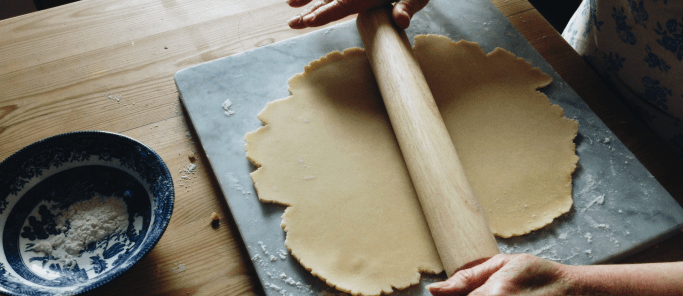
Sprinkle your work surface with semolina and flour (Yes! It gives the pastry a nice crunch) – use just flour if semiolina isn’t in your store cupboard. Place the dough ball on the surface and press gently with the side of your hand to flatten out. Next, using a rolling pin (preferably a long one with handles, lightly floured) gently roll out the dough, turning often, until you have a reasonably thin rectangle or circle to the shape of your plate or dish. Leave dough slightly thicker for a top crust.
Even suitable for vegans…
My youngest granddaughter is vegan, so I now make a version of the pastry for her – which the rest of the family say is as good and as tasty as my tried and trusted one.
Trex and Cookeen are the plant-based fats I’ve found to be best suited, although I’m sure many others are available. I’ve rubbed this with a half plain / half wholemeal self-raising mix (salt as in traditional pastry).
If you’ve read any of my life tales – then you’ll know I’d love to be demonstrating my methods. Nothing beats face-to-face and doing, not just talking. My eldest granddaughter (who understands this new fangled internet stuff!) suggested the blog and, you know what, I do feel as if I’m speaking to you – if anyone is actually taking any notice of course!
I’m leaving you now but I’ll be back – perhaps talking about scones (a similar method to pastry) and suet crust (traditionally used for meat based pies).
Bye for now. Definitely au revoir and not adieu.
I’d love to see if you test this recipe. Send me your pictures – I’m @gran.e.bakes on Instagram.
Sometimes the simplest bakes become the long-time favourites. If like me you like to spend lazy weekends baking (or everyday in lockdown), these are a perfect choice.
Chocolate Crunch.
Melt 8oz of butter in a pan
In a large bowl mix;
4oz [117g] of cornflakes, crushed with a rolling pin
3 oz [88g] desiccated coconut
5oz sugar (any – brown, white or mixed)
5oz SR flour
2 dessert spoons of cocoa powder (not hot chocolate!)
Add the melted butter to the dry mix
Have ready a well greased swiss roll tin 12”x8”
Press the chocolate mix into the tin, level off with the back of a large spoon
Place the tin in a pre-heated oven, 180 degrees, gas mark 4
Leave on the middle shelf for 20-30 mins
The mix should bubble gently then firm up
When slightly cooled, thickly cover with a mix of plain and milk chocolate (4-6oz)
Maybe add some crushed maltesers or any other left over chocolate, buttons, smarties and the like
Rough up the topping with a fork
Cut into squares whilst still in the tin, before completely cold or you won’t be able to cut smoothly
Lift out with a broad bladed implement when set
This is something quite young children can make, they especially love the sprinkling part. All my grandchildren made this, to be enjoyed by all ages.
Speedy Chocolate Cake.
Another easy, child-friendly bake. This dates back to my daughter’s younger years, this is a useful basic cake made special by the filling and topping.
You will need 2 x 8” sandwich tins, greased and lined with greaseproof paper. Pre-heat your oven to a medium setting – around 180 degrees, Gas Mark 4. Ingredient list:
7oz plain flour
2 tablespoons of cocoa
1 level teaspoon of baking powder
1 level teaspoon of bi-carbonate of soda
5oz of caster sugar (golden is best)
2 large eggs
¼ pint of milk (full cream is best!)
2 tablespoons golden syrup
¼ pint of corn or sunflower oil (yes, really!)
Mix all the dry ingredients in a large bowl. Beat the eggs and milk in a jug. Make a well in the centre of your dry ingredients, pour in the milk and egg mix then drizzle in the golden syrup and oil. Now beat this all together with a wooden spoon until you reach the consistency of pancake batter.
Don’t Panic!
Pour equal amounts into the two sandwich tins. Give a little tap on each tin – you should see bubbles in the mix. Place the tins into the middle of the oven and bake for 30-40 mins – depending on your cooker! The cakes should rise well and be firm(not hard) to the touch. Place the tins on a wire rack to cool.
Toppings and Fillings.
Now onto the special bit. The following are two of my favourites.
1. CLASSIC
A layer of jam (my preference is apricot) topped with butter cream (2oz each of butter and icing sugar whisked together with a little warm cream or milk with ½ a teaspoon of vanilla essence. Place the second cake on top and spread over some melted chocolate.
2. SPECIAL
You will need a tin of black cherries (drained but keep the syrup). I am a boozy cook so like to use alcohol to spice up mixes, sauces, fillings and toppings – most things actually! So, any sweet sherry, gin, white rum or liqueur remnants you may have around can be mixed with the cherry juice and boiled up to reduce a little. Sprinkle your cooling cake bases with this liquor before the toppings are spread.
Creamy fillings can be made with double whipped cream, mascarpone, cream cheese – any of these added to the basic butter cream.
Now fold in ½ of the cherries to cover one cake. Save a little of the creamy filling to mix with melted chocolate to cover the top layer and dot with the remaining cherries. A sprinkle of white chocolate can be a very good addition.
Experiment with other fruits or those small jars of ginger in syrup to make unusual but complimentary combinations.
Coffee and caramel blend beautifully with chocolate. And remember, do not use cooking chocolate, the normal stuff is best!
Enjoy!
Have you tried this recipe? I’d love to see your pictures – I’m @gran.e.bakes on Instagram.
Hello! This is me, Gran E; now into my 88th year, crumbling in the joints but hopefully not in the head.
Back to where it all started…
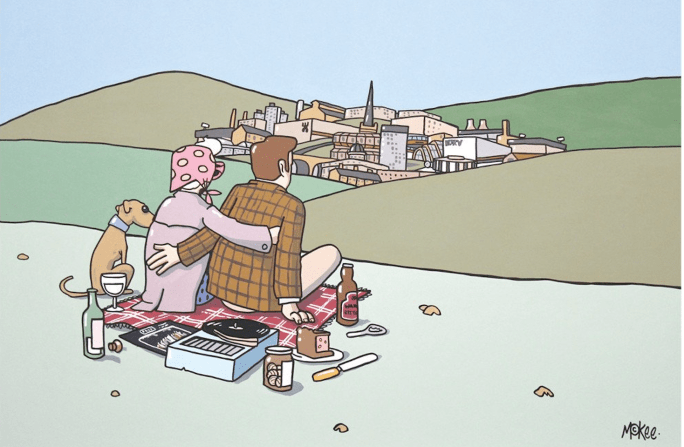
I was born, bred and drug-up in Pitsmoor, Sheffield (I’ll come back to the very early years later). I attended grammar school and passed my School Certificate at 15. My first job on leaving was as a nursery assistant from where I progressed to a full time teaching role with pre-school children. Then, at 16 I opened my own Dance School. I’d achieved qualifications in ballet from The Royal Academy of Dance having attended classes from the age of five. Stagecraft, music and dance were my life until I married. Then all that changed!
I had a wonderful daughter followed by a son and food took over, feeding family and friends. To start with (and ever since really!) it’s been trial and error – I had never cooked before. This feeling of discovery, of experimenting and finding new ingredients, recipes, methods and tastes, was and remains fascinating.
I’ll cover the very early years and my first experiences with cooking in the next instalment.










 Gran E Bakes